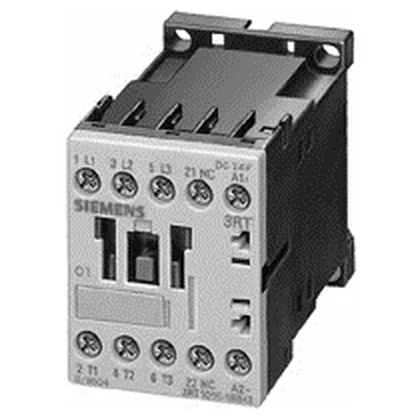
It's a three-pole contactor with screw-type terminals, rated for switching motor loads under AC-2 duty at 4 kW on a 400 V line. The coil is rated for 415 V at 50 Hz and 415 V at 60 Hz, so it's a straight 400 V class coil — common across European and Asian 400 V three-phase systems. The contactor holds in down to about 0.8x rated voltage at 50 Hz and 0.85x at 60 Hz, giving some brownout margin. For more severe switching (AC-4, reversing, plugging), it's rated 8.5 A at 400 V — that's the number to watch if you're jogging or inching the load.
Depth is 114 mm, height 57.5 mm. That depth includes the coil terminals and arc chambers, so account for it against the back panel or enclosure door. IP20 on the front and at the terminals — finger-safe but not washdown-rated; keep it inside a cabinet. The 2000 m maximum altitude rating covers most installations without derating.
Screw terminals accept 2x (0.5 to 1.5 mm²), 2x (0.75 to 2.5 mm²), or max 2x (0.75 to 4 mm²) — solid or stranded. AWG equivalents are 2x (20 to 16), 2x (18 to 14), and 1x 12. That's enough for the main circuit wiring on a 4 kW motor; the terminals are rated for 10 A continuous at AC-12 (resistive). The 20 A limit is the one to design to if you want to avoid replacing the contactor after a fault. Auxiliary contacts: the listing shows 1 N/O + 1 N/C instantaneous contact block. That's the standard single-deck block for feedback or interlocking. The contactor has a mechanical life of 30 million operations typical — that's the figure for the main contacts under light load; derate for AC-3/AC-4 duty.
The 45 mm footprint and screw terminals are common across the S00 family, so if you're swapping in a panel that was built around a different S00 variant, the mechanical fit is the same — just verify the coil voltage and auxiliary contact configuration.