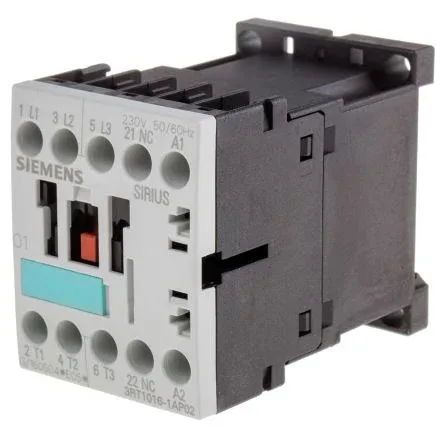
Rated for 4 kW at AC-2 duty on 400 V (slip-ring motors, wound-rotor applications) and 8.5 A at AC-4 on 400 V (plugging, inching, reversing duty). For standard squirrel-cage motors, the AC-3 rating is implied by the AC-2/AC-4 envelope, but the ledger doesn't carry an explicit AC-3 line; size S00 typically covers up to about 5.5 kW at 400 V AC-3, so treat that as a ceiling. Motor power ratings at higher voltages: 4.5 kW at 500 V and 5.5 kW at 690 V. These are the numbers to use if your line runs 500 V or 690 V three-phase — the contactor's thermal capacity scales with voltage in those duty classes. Auxiliary contact ratings: 10 A at 24 V, 2 A at 60 V, 1 A at 110 V, 0.3 A at 220 V, 6 A at 230 V, 3 A at 400 V. That 0.3 A at 220 V is the weak link — if your control circuit runs 220 VDC and needs more than 0.3 A through the aux, you'll need an interposing relay. Coil holds at 110 V DC nominal, pull-in and holding power both 3.3 W DC. Operating range is 0.85 to 1.1.
Wire sizes: 2x (0.5 to 1.5 mm²), 2x (0.75 to 2.5 mm²), max 2x (0.75 to 4 mm²) solid or stranded. AWG equivalents: 2x (20 to 16), 2x (18 to 14), 1x 12. That's enough for up to 4 mm² on the main terminals — common for a size S00 contactor feeding a 4 kW motor. Fuse coordination: Type 1 requires a 35 A gL/gG fuse; Type 2 requires a 20 A gL/gG fuse. If your panel spec calls for Type 2 (no damage to the contactor under short circuit), use the 20 A fuse — don't oversize it or you lose the coordination.
Electrical life depends on the load and duty class; for AC-4 at 8.5 A expect significantly fewer cycles before contact replacement. The 30 million figure tells you the actuator won't wear out before the contacts do. RoHS compliance date is 01.07.2006.