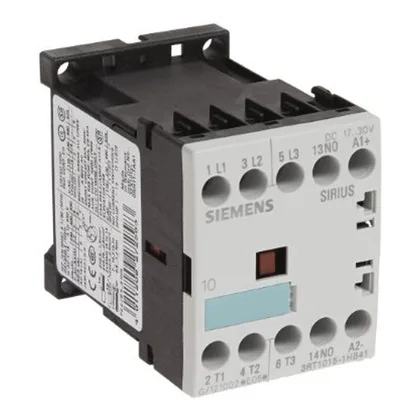
What it is and what it does
The Siemens 3RT1016-1KB41 is a SIRIUS power contactor in size S00, designed for switching motor loads in control panels. Its AC-3 rating at 400 V is 10 A, which means it handles standard squirrel-cage motor starting and disconnecting up to that current — the rating that governs real motor duty, not just resistive loads. The coil is 24 VDC, drawing 2.3 W for both closing and holding, so the control transformer or DC supply needs to deliver that steady-state load continuously. It mounts via screw and snap-on onto a 35 mm DIN rail per DIN EN 50022, and side-by-side mounting is permitted — no gap required between contactors in a row, which saves panel width.
Key ratings and what they mean for fit
The AC-3 rating at 400 V is 10 A (4.5 kW at 500 V, 5.5 kW at 690 V), so for a 4 kW motor on a 400 V supply this contactor has headroom. The AC-4 rating at 400 V is 8.5 A — that's the inching/plugging duty cycle rating, lower than AC-3 because of the higher switching stress. For resistive loads (AC-1), the contactor is rated 20 A at 400 V, but the AC-2 rating at 400 V is 4 kW — that covers wound-rotor motor duty where the starting current is controlled. The auxiliary contact ratings span 10 A at 24 V down to 0.3 A at 220 V — useful for interlocking or PLC input circuits at lower voltages. Pollution degree 3 means it's rated for industrial environments where conductive pollution occurs — typical for control panels in factory floors, not clean rooms. The built-in varistor surge suppressor protects the coil from voltage spikes; no external suppressor module needed for basic applications.
Wiring and termination
Main and auxiliary/control circuits use screw-type terminals. Wire sizes accepted: 2x (0.5 to 1.5 mm²), 2x (0.75 to 2.5 mm²), or max 2x (0.75 to 4 mm²) solid or stranded. For AWG: 2x (20 to 16), 2x (18 to 14), or 1x 12. Type 2 coordination (no damage to the contactor on short circuit) requires a gL/gG fuse rated 20 A. Type 1 coordination (contactor may need replacement after fault) allows a 35 A fuse.
Lifecycle and sourcing
The RoHS compliance date is July 1, 2006, so it meets the original EU RoHS directive. The reference code per IEC 81346-2 is Q, meaning it's classified as a switching device in the system.
