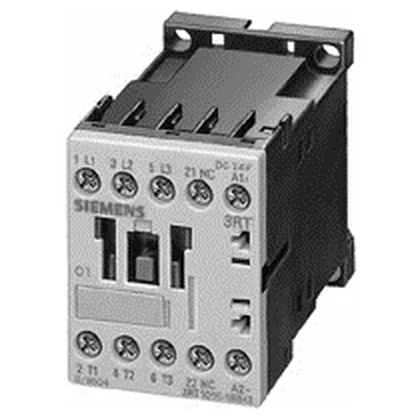
Side-by-side mounting is allowed without derating, and the 6 mm clearance to adjacent devices is the minimum for air circulation and arc containment. The IP20 finger-safe front and terminals mean it's meant for enclosed panels, not washdown zones. Terminals accept 2x (0.5 to 1.5 mm²) solid or stranded, 2x (0.75 to 2.5 mm²), or up to 2x 4 mm². The AWG equivalent is 2x 20–16, 2x 18–14, or 1x 12 — plenty of room for standard panel wire without fighting the lug.
The contactor's main contacts carry different current ratings depending on the load voltage and duty cycle. At 24 V it's rated 10 A, at 230 V it's 6 A, and at 400 V it's 3 A. For motor power at 690 V, it's rated 5.5 kW — that's a solid number for a small-frame contactor on a 690 V line. For DC switching at 60 V it's rated 2 A, at 110 V it's 1 A, and at 220 V it drops to 0.3 A. If you're switching DC loads, the 220 V rating is the one to watch — it's a hard limit, not a suggestion.