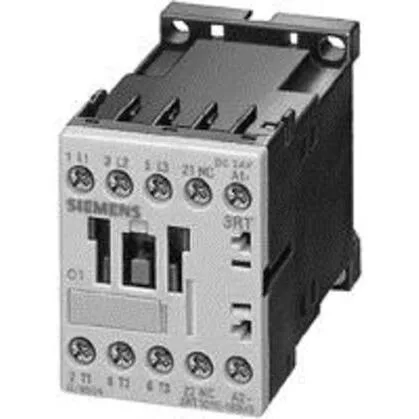
S00 power contactor with spring-loaded terminals
The IP20 finger protection on the front and terminals means it's safe for open-panel installation where operators reach in for maintenance.
The headline rating is 10 A in AC-12 duty (resistive loads at line frequency). That's the maximum continuous current the main contacts can carry when switching resistive heaters, lighting banks, or transformer primaries. At higher voltages the contactor delivers 4.5 kW at 500 V and 5.5 kW at 690 V — both AC-3 duty, the standard for starting squirrel-cage motors and disconnecting after they're up to speed. The coil pulls 3.3 W on closing and holds at 3.3 W, so the DC supply needs to source about 140 mA continuous per contactor.
Spring-loaded terminals accept 2x (0.25 to 2.5 mm²) solid or stranded wire, or 2x (24 to 14 AWG). No screwdriver torque required — strip 8 mm, push in, done. The side-by-side mounting clearance is 6 mm, so you can pack contactors tight on the rail without derating, provided the ambient stays within the -25 to +60 °C window.
Short-circuit coordination
These are the fuse sizes that limit let-through energy so the contactor's welds stay within acceptable limits.