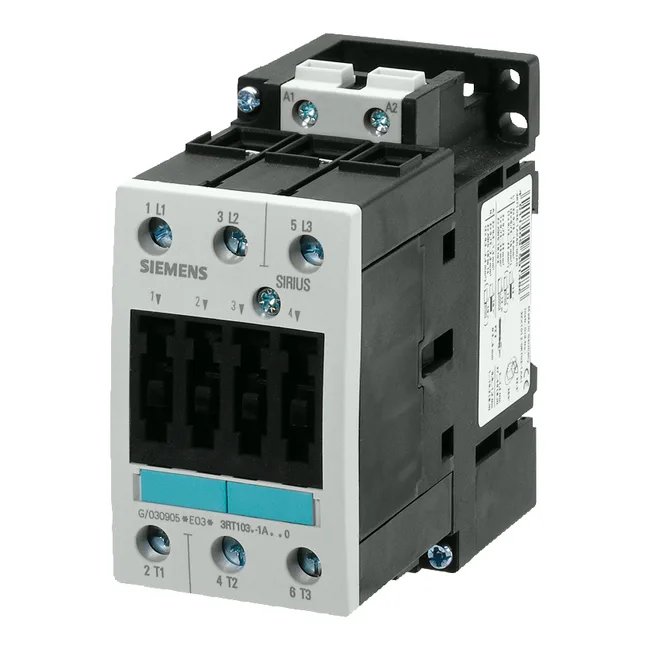
What it is and what it does
The Siemens SIRIUS 3RT1034-1BB80 is a size S2 power contactor with a 24 VDC coil and screw-type main terminals. It is rated for 18.5 kW motor load at 500 V under AC-3 duty, and 15 kW at 400 V under AC-2 duty — the AC-3 figure governs across-the-line starting of standard squirrel-cage motors, while AC-2 covers slip-ring or wound-rotor motors where starting current is lower but switching frequency matters. The coil draws 10 A at 24 V rated value, which is the inrush to pull the armature in; the holding current settles lower. Dropout voltage is not listed here, but the arcing time of 10 to 15 ms and DC operate time of 20 to 30 ms give a window for contactor sequencing in safety circuits.
Mounting and integration
Mounts via screw or snap-on onto 35 mm DIN rail per DIN EN 50022 — the snap-on feature speeds replacement on a live rail without tools. Side-by-side mounting is permitted (no derating gap), which keeps panel width tight. Front face carries IP20; the terminal area is IP00, so finger-safe shrouds are needed on exposed screw terminals inside the enclosure. Wire range: solid accepts 2x (0.5...1.5 mm²) and 2x (0.75...2.5 mm²) up to 2x (0.75...4 mm²); stranded accepts 2x (0.75...25 mm²). At 40 °C the minimum permissible conductor is 16 mm² — that's the thermal limit for the main circuit under full load, not a wiring convenience spec.
Lifecycle and compliance
Storage temperature range of -55 to +80 °C covers cold warehouses and hot shipping containers; operating range is -25 to +60 °C — the operating limit is the one that governs panel ambient, not the storage number.
Switching rates and mechanical life
Maximum switching rates: 1 200 cycles/hour at AC-1 (resistive), 750 at AC-2, 1 000 at AC-3, and 250 at AC-4. The AC-4 rate is the constraint for heavy jogging or plugging duty — 250 cycles/hour means roughly one reversal every 14 seconds, which matches typical crane or winch control. Mechanical life is 10 million operations typical; electrical life depends on the switched current and duty cycle.
