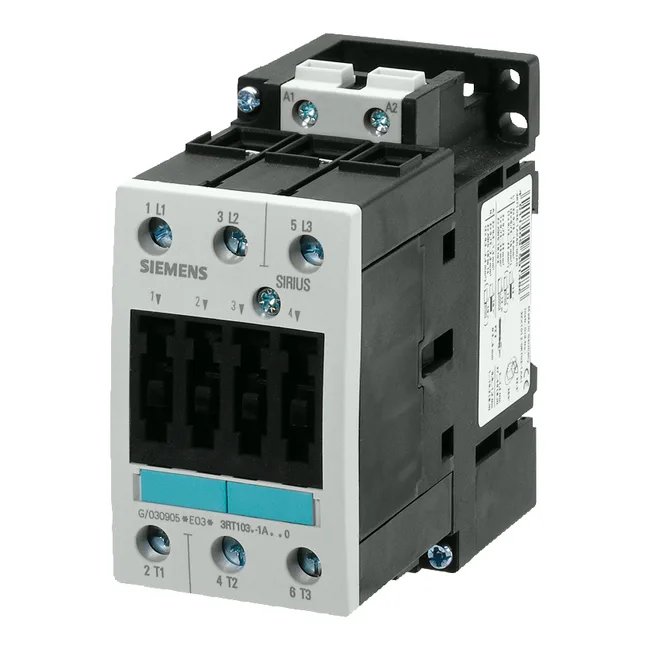
The Siemens 3RT1034-1BD40 is a SIRIUS-brand power contactor in the S2 frame size, rated for motor switching duty. It handles AC-3 loads up to 1000 operations per hour, delivering 18.5 kW at 500 V and 10 kW at 690 V. That figure governs the contactor's wear-out interval in high-cycle applications like stamping presses or packaging lines — plan spares around it, not the electrical endurance.
Where it fits — panel and environment
The 55 mm width and 112 mm height fit standard DIN-rail enclosures. Depth is 130 mm, which clears most 200 mm deep cabinets with room for wiring ducts. For high-ambient panels near ovens or foundry lines, the +60 °C ceiling is the limit — above that, derate per the thermal curve.
Arcing time is 10 to 15 ms at DC, and the contactor's DC switching capability is specified by voltage: 10 A at 24 V, 2 A at 60 V, 1 A at 110 V, 0.3 A at 220 V. These are the make-and-break ratings for DC loads — inductive loads like DC brake coils or solenoid valves need the lower end of the curve. AC switching frequencies: AC-1 resistive loads up to 1200 ops/h, AC-2 slip-ring motors at 750 ops/h, AC-3 squirrel-cage at 1000 ops/h, AC-4 plugging/inching at 250 ops/h. At 400 V, the contactor is rated 15 kW in AC-2 and 29 A in AC-4. The AC-2 rating applies to wound-rotor motors where the starting current is lower; AC-4 covers the full locked-rotor current during reversing.
RoHS compliance date is May 1, 2012, covering the EU RoHS directive. The contactor carries no built-in auxiliary contacts or surge suppression — those are ordered separately as add-on blocks.