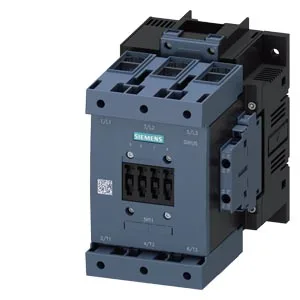
Its coil is rated for 23 to 26 VDC, so a nominal 24 VDC control supply is the target; the pickup and dropout timing sits between 40 and 60 ms for both AC and DC energisation, and the arcing time spans 10 to 15 ms — numbers that matter when sequencing contactors in a motor starter or reversing circuit. The main power circuit accepts stranded conductors from 16 to 70 mm², which is typical for the S6 frame size and the motor currents this contactor handles.
Switching frequency and duty capability
Maximum switching rates are given per utilisation category: 800 cycles per hour at AC-1 (resistive), 750 at AC-3 and AC-3e (standard squirrel-cage motors), 300 at AC-2 (slip-ring motors), and 130 at AC-4 (plugging / inching). For a motor-starting application under AC-3 duty, the 750 cycles/hour ceiling means the contactor can handle frequent starts — a conveyor or pump cycling every 4.8 seconds — provided the thermal load stays within the contactor's design limits. The AC-4 rate of 130 cycles/hour is the limiting case for reversing or jogging duty; exceeding that will overheat the arc chutes and reduce contact life.
The built-in auxiliary switch is rated for 10 A at 24 V, 2 A at 48 V and 60 V, 1 A at 110 V, 0.9 A at 125 V, and 0.3 A at 220 V — all at the rated voltage of the respective DC control circuits. These ratings are for the DC-13 load category (solenoid valves, contactor coils, relays) and define the maximum current the auxiliary contacts can break inductively at each voltage level.
Mechanical endurance and environmental limits
Mechanical endurance is quoted at 10 million operating cycles, which is the typical figure for a contactor of this frame size and build quality — it reflects the life of the mechanism before any electrical wear is considered. Operating temperature range is -25 to +60 °C, with storage from -55 to +80 °C; the mounting position allows vertical surface mounting with +/-90° rotation and +/-22.5° tilt forward and back, so it fits in most standard panel layouts.
Wiring and connection details
The main power circuit uses screw-type terminals accepting 16 to 70 mm² stranded conductors; the auxiliary circuit terminals accept solid or stranded conductors in two sizes per clamp: 2x 0.5 to 1.5 mm² or 2x 0.75 to 2.5 mm², with a maximum of 2x 0.75 to 4 mm². The coil terminals are also screw-type, so the entire contactor can be wired with a single screwdriver type — no mixed tooling needed on the panel assembly line. Fastening is by screw fixing, not snap-on DIN rail; the S6 frame is bolted directly to the mounting plate, which is standard for larger contactors where vibration resistance matters more than quick removal.
There is no official successor or replacement part listed — the 3RT1055-1AB36 is the current build state for this S6 contactor variant.