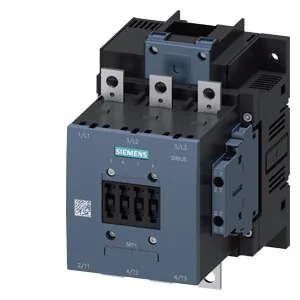
It's the main switching device for motor loads and resistive heating banks in industrial control panels — the sort of thing you'd find on a MCC bucket or a standalone motor starter enclosure. The coil is rated for 575 to 600 VAC at 50/60 Hz, which means it's built for 600 V class control circuits common in North American and some export panels. Coil termination is screw-type, so you're landing ring or fork terminals, not spring cages.
Mounting and Clearance — What the Panel Guy Needs
Mounting is screw-fixing through a single 9 mm hole, not DIN rail — plan for a drilled backplate. The contactor can sit on a vertical surface and be rotated ±90° or tilted ±22.5° front-to-back, which gives some flexibility for cable entry orientation. Keep at least 10 mm clearance above and below, 10 mm to the sides, and 20 mm in front for arc flash and cooling. That's tighter than some older S6 frames, so check your existing gland plate layout if you're retrofitting.
Ratings That Drive the Application
The main power path accepts stranded conductors from 25 to 120 mm² — that's good for motor feeds up to around 200-250 A depending on duty cycle and ambient. The auxiliary switch (built-in) handles 10 A at 24 V, 2 A at 48 V or 60 V, and 1 A at 110 V. For resistive loads (AC-1), you can cycle it up to 800 times per hour. For standard motor starting (AC-3), it's 750 cycles per hour. Heavy inching or plugging (AC-4) drops that to 130 cycles per hour. The rated power factor at operational current is 0.8 at both 50 and 60 Hz, so it's designed for typical induction motor loads.