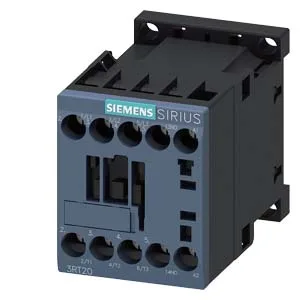
The Siemens 3RT2015-1AU61 is a SIRIUS power contactor in the compact S00 frame — 45 mm wide, 58 mm tall, 73 mm deep — built for switching motor loads and resistive circuits in control panels. The 24 VDC coil with screw-type terminals is the standard pick for PLC-driven outputs where you want a clean pull-in without the AC hum. The headline number most buyers care about is the switching frequency per duty class: 750 operations per hour in AC-3 (motor starting) and AC-3e, 1 000 ops/h in AC-1 (resistive), and 250 ops/h in AC-4 (plugging/reversing). That AC-3 ceiling tells you this contactor is sized for moderate-duty motor cycling — think conveyors, pumps, compressors running a few starts per minute — not high-speed indexing or jogging. The AC-4 limit is the one that catches people out: if your application reverses or plugs the motor under load, you need to stay under 250 ops/h or step up to a larger frame. Auxiliary contact ratings are given across the voltage range: 10 A at 24 V, 3 A at 400 V, 4.8 A at 480 V. That 480 V figure is useful for 480 VAC control circuits common in North American panels — the contactor can switch pilot lights, PLC inputs, or relay coils at that voltage without derating the auxiliary path.
Mounting and wiring — what fits where
S00 frame takes 45 mm of rail width. Terminals accept solid or stranded wire: 0.5 to 4 mm² single, or two conductors per clamp (2x 0.5–1.5 mm², 2x 0.75–2.5 mm², 2x 4 mm²). Screw-type clamp.
Temperature range — where it lives in the panel
If your panel sits in a foundry or a refrigerated warehouse, the operating range is the one to watch; the storage spec is just handling tolerance.