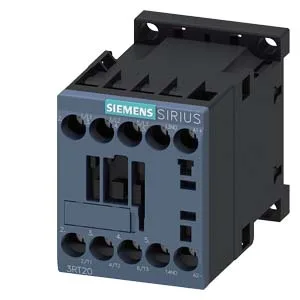
SIRIUS 3RT2015-1KB41 — Coupling Contactor, S00 Frame, 24 VDC
The 24 VDC coil is rated for continuous duty, with a pickup dropout ratio around 0.7 of rated voltage — meaning it holds in reliably down to roughly 16.8 V and drops out cleanly below that, which matters when sizing a 24 VDC power supply shared with PLC outputs or sensors. Main contact ratings: 10 A at 24 VDC, 3 A at 400 VAC. The DC switching capacity drops significantly with voltage — 2 A at 48 V, 0.3 A at 220 V — so verify the load curve against your circuit before committing the BOM line. AC-1 resistive switching goes up to 1,000 operations per hour; AC-3 motor duty is rated at 750 ops/h. Arcing time runs 10–15 ms, which is typical for this contactor class and means the arc extinguishes fast enough for most relay-coil and small-motor loads without external suppression.
Panel Integration & Wiring
The S00 frame keeps the contactor compact at 58 mm tall and 73 mm deep, leaving room alongside terminal blocks or a PLC rack. Clearances: 10 mm upwards and forwards, 6 mm at the sides, 10 mm downwards — enough for standard wiring ducts without crowding. The -25 °C lower limit is fine for most indoor panel environments but check if your application sees freezing conditions in an unheated enclosure — the contactor will start and hold, but the coil inrush at low temperature draws higher current, so verify the 24 VDC supply can deliver the peak.