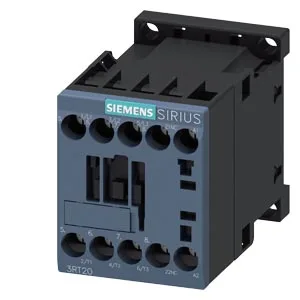
Wiring and Termination — What the Specs Actually Tell You
The main contact coil terminates to screw-type terminals, which is the standard for this frame. Wire capacity is generous for the size: solid or stranded from 0.5 mm² up to 4 mm², and you can double up — 2x (0.5 to 1.5 mm²), 2x (0.75 to 2.5 mm²), or 2x 4 mm². That's enough for the control wiring you'll typically see on a Size S00 contactor. Keep an eye on clearance. That's the minimum air gap for arc quenching and heat dissipation — don't cram it tighter.
Switching Performance and Operating Conditions
The magnet coil pulls in at 7 to 13 ms, and the main contacts clear an arc in 10 to 15 ms — fast enough for most motor-starting and general switching duties. Rated switching frequency varies by duty: AC-1 (resistive) maxes at 1,000 cycles per hour, AC-2 and AC-3 (motor starting/running) at 750, and AC-4 (plugging/reversing) at 250. If you're cycling a motor hard, derate accordingly. The auxiliary contact block handles a range of voltages and currents — 10 A at 24 V, 2 A at 48 V and 60 V, 1 A at 110 V, 0.9 A at 125 V, 0.3 A at 220 V, 3 A at 400 V, and 0.2 A at 440 V. That's typical for a signal-level auxiliary, not a power circuit. That gives you options in a tight panel.
Sourcing Reality
This is a current-production part, so it's available through standard Siemens distribution channels. No last-time-buy worries, no surplus-hunting. If you're filling a BOM line or replacing a failed contactor in a live panel, the 3RT2016-1AP02-ZW97 is a straightforward specify-and-order item.