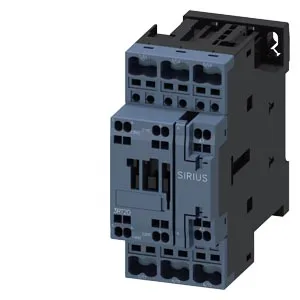
Siemens 3RT2023-2AF00 SIRIUS power contactor — Size S0, spring-terminals, current lifecycle
It mounts via screw fixing or snap-on onto 35 mm DIN rail per DIN EN 60715, occupying 45 mm of panel width with a 97 mm depth and 102 mm height — a standard S0 footprint that fits existing S0 busbar and overload relay layouts without re-drilling. The coil draws 0.25 A at 50 Hz, and the auxiliary contact block (1 NO + 1 NC, per the 18...8 designation for main contacts) carries rated currents from 10 A at 24 V down to 0.3 A at 230 V and 0.6 A at 440 V — enough for PLC inputs, pilot lights, and small relay coils in the control circuit. Switching frequency reaches 1,000 cycles per hour under AC-1, AC-2, AC-3, and AC-3e duty, dropping to 300 cycles/h under AC-4 for plugging or inching applications — a realistic limit for conveyor jogging or press indexing where the contactor sees frequent make-break under load.
Mounting and wiring — DIN rail footprint and spring-clamp wiring
Clearances: 10 mm upwards, 10 mm forwards, 10 mm downwards, and 6 mm at the side — tight enough for dense S0 rows but check the arc-chamber vent path if you stack multiple contactors side-by-side without a separator. Spring-type terminals accept solid or stranded conductors from 1 to 10 mm², or 2 × (0.5 to 2.5 mm²) for daisy-chaining control wiring. No screw torque to verify — strip to the correct length (typically 10 mm for spring clamps this size) and push in. The arcing time is listed at 10 ms, which is typical for a contactor of this class and means the arc extinguishes fast enough to avoid welding on moderate overloads.
Thermal limits and lifecycle
Mechanical endurance of the contactor typical is 10 million operations — a number that assumes no load on the main poles. Electrical endurance depends on the switching category and load current; the 1,000 cycles/h AC-3 rating gives a practical benchmark for motor-starting duty on a conveyor or pump.