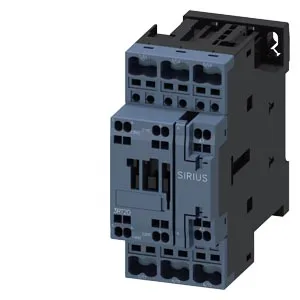
Clearances: 10 mm upwards, downwards, and forwards; 6 mm at the sides. That 97 mm depth means it'll sit flush in a standard 120 mm deep enclosure without the gland plate hitting the back wall.
The auxiliary switch terminals take 2x (0.5 to 2.5 mm²) solid or stranded. Spring-type terminals on the coil mean no screwdriver torque check — push the wire in, it's done. That's one less thing to verify during panel build-out.
Duty cycle and switching life
Rated for 1,000 switching cycles per hour at AC-1, AC-2, AC-3, and AC-3e duty; drops to 300 cycles per hour at AC-4 (the heavy inching/jogging duty). For a conveyor line running at one cycle every 3 seconds, that's about 8,300 hours of continuous operation before mechanical wear becomes a consideration.
Built-in auxiliary switch rated at 10 A at 24 V, 3 A at 400 V, and 1 hp at 230 V. That 10 A at 24 V covers most PLC input modules and small relay coils without an interposing relay. If you're switching a 48 VDC indicator bank, it's good for 2 A.
Environmental range
That -25 °C low end is fine for unheated warehouses in most climates; the +60 °C top end means it'll sit next to a drive or transformer in a sealed panel without derating.