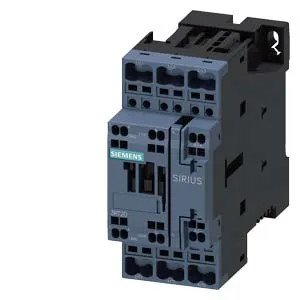
It carries a 24 VDC coil and uses spring-type terminals for fast wiring without screw torque checks. The contactor snaps onto a 35 mm DIN rail per DIN EN 60715 and can be rotated ±180° on a vertical surface or tilted ±22.5° forward/backward, which gives panel builders flexibility in tight enclosures. At 45 mm wide and 107 mm deep, it fits standard DIN-rail spacing and leaves room for adjacent devices. The height is 85 mm.
The DC coil operates at 24 V rated value, with a pick-up/drop-out time between 15 and 17.5 ms. That 15–17.5 ms window is the mechanical response — the arcing time sits at 10 ms, so the total break time is predictable for coordination studies. The coil draws 6 A at 24 VDC inrush, settling to a lower hold current, so size your 24 VDC supply with that peak in mind. Spring-type terminals accept solid or stranded wire from 1 to 10 mm², or two conductors of 0.5 to 2.5 mm² each. That covers most control and power wiring in a typical panel — no ferrule crimping needed for solid wire, which speeds up termination on a build. Electrical switching frequency maxes out at 1,000 cycles per hour for AC-1, AC-2, AC-3, and AC-3e duty, dropping to 300 cycles per hour for AC-4 (plugging/reversing). That 300 c/h limit on AC-4 is the one that catches people out on high-cycle reversing applications.