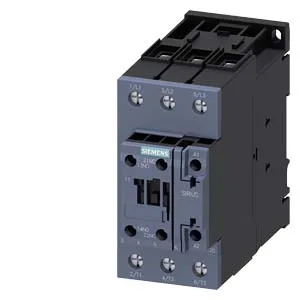
Duty-cycle limits — which switching rate governs your application
The 3RT2036-1NB30-0UA0: The rated switching rates per duty class: AC-1 (resistive) at 1000 operations/hour, AC-2 (slip-ring motors) at 600/h, AC-3 and AC-3e (squirrel-cage motors, starting only) at 800/h, and AC-4 (plugging, inching, jogging) at 250/h. The AC-4 rate is the thermal limiter — if your cycle includes reversing or inching, that 250/h ceiling is the one that governs contact life, not the AC-3 number.
Coil circuit — control voltage and inrush
Rated control voltage range is 20-33 V. The pickup threshold is 0.8× rated (16 V minimum to pull in), and the dropout threshold is 1.1× rated (36 V) — that dropout margin means the contactor stays sealed through a moderate brownout, but if the bus dips below 36 V it drops out cleanly. Inrush current peaks at 3 A, and holding power is 2 VA at both 50 and 60 Hz. For a control transformer sizing exercise, the inrush is the number that matters — the holding draw is negligible. That dual-wire capacity is handy for daisy-chaining the control voltage to multiple contactors in a group.
Auxiliary contacts and DC ratings
The contactor ships with an auxiliary switch block integrated — no separate add-on needed for basic status feedback. If your control circuit runs at 48 VDC, that 2 A rating is the number to check against your PLC input load.