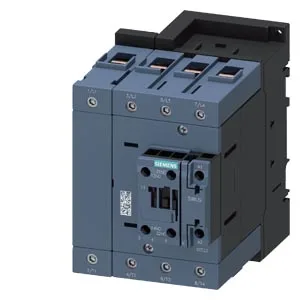
The coil accepts 20 to 33 V AC/DC, drawing 3.5 VA at both 50 Hz and 60 Hz, with an inrush peak of 6.5 A. That 3.5 VA hold power is the same at both line frequencies, so no derating needed when switching between 50 Hz and 60 Hz supply regions.
Size S3 is the frame size. The main contacts are rated for 10 to 2 A. The auxiliary contact block is built in (yes on auxiliary switch), with screw-type terminals. The auxiliary contacts are rated at specific voltages: 10 A at 24 V, 2 A at 48 V, 6 A at 60 V, 1 A at 110 V, 0.9 A at 125 V, 0.3 A at 220 V, and 6 A at 230 V. The 10 A at 24 V is generous for a 24 VDC control loop; the 0.3 A at 220 V is typical for a 220 VAC pilot light or relay coil.
Dimensions: 140 mm high, 96 mm wide, 152 mm deep. The 96 mm width is three 32 mm modules wide on a DIN rail — standard for a size S3 contactor. The 152 mm depth includes the coil terminals and any auxiliary block; check clearance behind the panel door. These are minimum air gaps for heat dissipation and arc quenching — don't crowd the contactor against other components or the enclosure wall. Main circuit wiring accepts stranded conductors from 6 to 70 mm². Auxiliary circuit wiring accepts solid conductors: 2x (0.5 to 1.5 mm²) or 2x (0.75 to 2.5 mm²). The 70 mm² main terminal is large enough for a 50 A feed; the auxiliary terminals are sized for standard control wiring. This helps when the contactor must be mounted at an angle in a tight cabinet or on a swing frame. Up to 2 auxiliary switches can be attached. The operating range factor is 0.8 (initial) to 1.1 (full-scale) of rated voltage.
No last-time-buy constraints, no broker-channel dependency. If you're freezing a BOM for a new line or filling an MRO spare, this is a clean active part to specify.