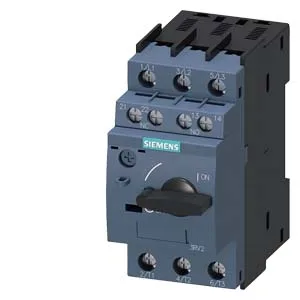
The breaker is rated for a continuous voltage range of 20 to 690 V, with a Trip Class 10 characteristic that clears overloads within 10 seconds at 7.2× set current — standard for general-purpose motor starting where the inrush transient is brief.
Short-circuit breaking capacity reaches 100 kA at 240 V, 400 V, 500 V, and 690 V — a flat high-fault curve that simplifies panel coordination because you don't need to derate for higher line voltages within that range. For motor protection at 230 V, the breaker supports a 0.1 kW motor load — a small rating that suits fractional-horsepower pumps, fans, or conveyor drives on a low-voltage line. The auxiliary contact block provides 1 A at 24 V, 0.5 A at 120/125/230 V, and 0.15 A at 60 V — enough for PLC-level signal feedback or contactor coil holding in a 24 VDC control circuit.
Integration and wiring
Terminals are screw-type for the main current circuit, accepting 2× (0.5 to 1.5 mm²) or 2× (0.75 to 2.5 mm²) solid or stranded copper — strip length per standard practice, no special tooling needed.
No ground fault detection is built in (separate RCD or GFCI required if needed). The design is strictly for motor overload and short-circuit protection with phase failure detection.