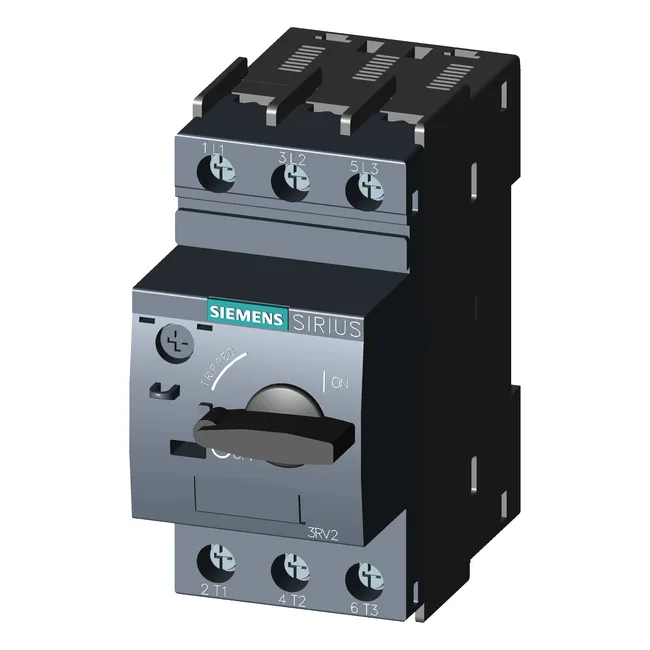
It is a current-production part, still in the catalog as an active line item. The 100 kA breaking capacity at 400 V (also at 240 V, 500 V, and 690 V) means this breaker can safely interrupt a bolted fault on a high-capacity distribution bus without welding its contacts or venting arc gas into the panel.
The 45 mm width (3 module spaces) is standard for this current range. Depth is 97 mm, height 97 mm — it does not overhang a standard 100 mm deep enclosure backplate. Mounting position is any, so you can lay it sideways in a shallow gland-top panel if needed. Zero clearance forward — the breaker face can sit flush against a door or cover.
Main circuit terminals are M3 screw-type. Wire capacity: 2× (0.5 to 1.5 mm²) or 2× (0.75 to 2.5 mm²) solid or stranded. That covers most panel-building practice for motor circuits up to this size — no need for ferrules on stranded if you strip clean, but ferruled ends seat better in the cage.
Operating conditions and ratings
The voltage range across the main contacts is 20 to 690 V — covers everything from 24 V control transformers up to 690 V industrial mains. Auxiliary contact ratings: 1 A at 24 V, 0.5 A at 120/125/230 V, 0.15 A at 60 V. Maximum switching rate in AC-3 duty is 15 operations per hour. Rated motor power at 230 V is 0.2 kW — that is the smallest motor this breaker can protect on a 230 V line.