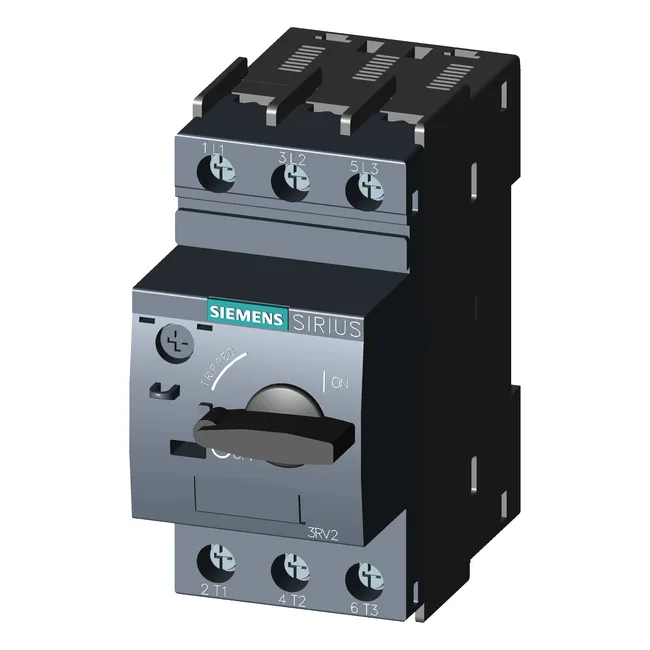
The Siemens 3RV2011-1AA10-ZW97 is a SIRIUS motor protection circuit breaker, designed to protect motor circuits against overload and short-circuit. It carries a Class 10 trip characteristic, meaning it will trip within 10 seconds at 7.2× the thermal setting — fast enough to protect standard induction motors during a locked-rotor event. Rated breaking capacity hits 100 kA at 400 V AC, so it can interrupt a high-fault bolted short without upstream fuses needing to coordinate. Phase failure detection is built in, so a single-phased motor will trip on the healthy phases rather than burn out. Mounting is screw-and-snap-on to 35 mm DIN rail per DIN EN 60715, and the 45 mm width means it occupies one standard 45 mm module slot in the panel.
Mounting & Integration
Fastens with screw clamps or snaps onto 35 mm DIN rail (DIN EN 60715). Mounting position is any orientation, which simplifies layout in tight enclosures. Clearance: 50 mm above and below, 30 mm to the sides, zero forward or backward — so it can sit flush against a backplate or gland plate. Terminals accept 2×(0.75…2.5 mm²) solid or stranded, or 2×4 mm², with M3 screws on the main contacts.
Ratings & What They Mean
The 100 kA breaking capacity at 240 V, 400 V, 500 V, and 690 V AC means this breaker can safely clear a bolted fault up to that level without needing a backup fuse — it's a self-protected device for most industrial supply transformers. The Class 10 trip curve is the standard for general-purpose squirrel-cage motors; if you're protecting a high-inertia load (centrifuge, crusher) that needs a longer acceleration ramp, you'd want a Class 20 or 30, but for pumps, fans, and conveyors this is the right call. Maximum operating frequency is 15 switching cycles per hour in AC-3 and AC-3e duty — that's the thermal limit of the bimetal, not the mechanical endurance.
