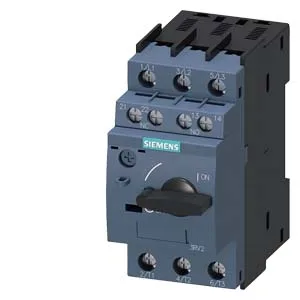
It combines a thermal-magnetic overload relay and a short-circuit trip in one device, with Class 10 trip class. Breaking capacity reaches 100 kA at 400 V and 500 V, and 10 kA at 690 V. On a lost phase, the thermal element sees reduced current on the remaining phases and trips earlier than a standard three-pole thermal relay would — prevents single-phasing damage to the motor.
Depth is 97 mm, height 97 mm. Clearance requirements: 50 mm upwards and downwards, 30 mm at the side, 0 mm forwards and backwards. The zero forward/backward clearance means it can sit flush against a panel backplane or door — useful when packing breakers into a tight row. Main contact terminals accept 2×(0.5…1.5 mm²) or 2×(0.75…2.5 mm²) solid or stranded, screw type M3.
Switching capacity and auxiliary ratings
Auxiliary contact ratings: 1 A at 24 V, 0.5 A at 120/125/230 V, 0.15 A at 60 V. These are for the control circuit — not the main power path. The 24 V 1 A rating is enough for a PLC digital input or a relay coil; the 60 V 0.15 A figure is the low-voltage DC limit. Maximum operating frequency: 15 switching cycles per hour for AC-3 and AC-3e duty.
Environmental limits
Storage and transport range -50 to +80 °C. The storage range is wider — that's the handling limit, not the running limit.