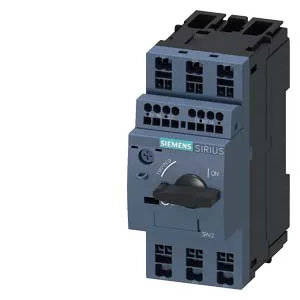
Rated breaking capacity hits 100 kA at 400 V AC and 500 V AC, and 10 kA at 690 V AC. Ground fault detection is not included — that requires an external residual-current device. Spring-loaded terminals accept 2× 0.5 to 2.5 mm² solid or stranded wire, which covers the control-circuit wiring typical for this class. No screwdriver needed for termination — push the lever, insert the conductor, release.
Width is 45 mm — a standard 2.5-module footprint that fits most motor starter assemblies. Depth is 97 mm; height 106 mm. Clearance requirements: 50 mm upward and downward, 30 mm at the side. That 30 mm side gap is tighter than some competitors — verify adjacent device spacing before laying out the DIN rail.
Switching capacity and auxiliary ratings
Auxiliary contact ratings: 1 A at 24 V, 0.5 A at 120/125/230 V, 0.15 A at 60 V. These are the switching currents for the built-in auxiliary contacts — useful for PLC input signals or contactor coil control. The 0.15 A at 60 V is notably low; if driving a 60 VDC load, confirm the draw is under that limit. Short-circuit protection coordination (gL/gG fuses): 25 A at 400 V, 32 A at 500 V, 25 A at 690 V. These are the maximum upstream fuse ratings that still allow the breaker to clear a fault without damage to itself. Maximum electrical switching frequency is 15 operations per hour under AC-3 and AC-3e duty — typical for motor start/stop cycles. Higher frequency requires derating or a contactor with a higher utilization category.