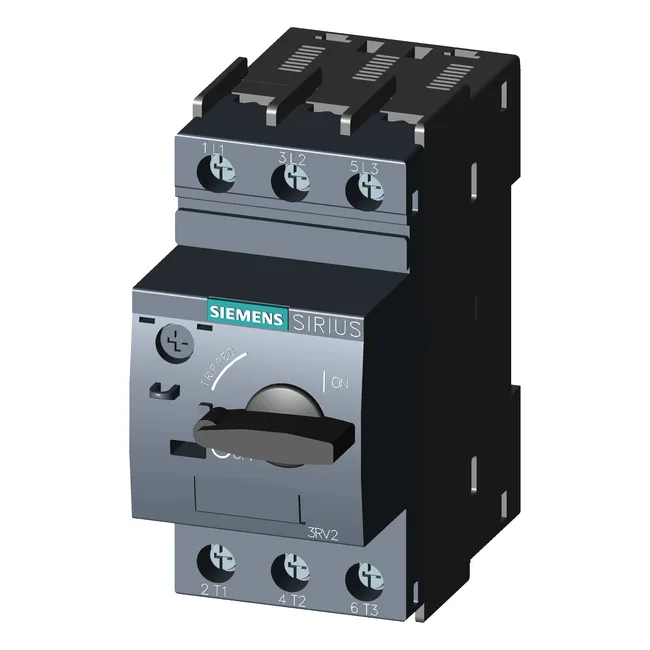
The spring-loaded terminals accept 2x (0.5... 2.5 mm²) solid or stranded wire, which saves panel wiring time compared to screw terminals. This is a current-production part.
DIN rail fit and spacing
The 3RV2011-1EA25-ZW97 measures 45 mm wide, 106 mm tall, and 97 mm deep. That 45 mm width is three standard 15 mm module slots on a DIN rail — a common footprint for a motor protection breaker in this class. For side-by-side mounting, the minimum clearance to adjacent devices is 30 mm at the side, 50 mm upwards, and 50 mm downwards. Zero clearance forwards and backwards means it can sit flush against a back panel or enclosure wall.
At 690 V the capacity drops to 4 kA — still sufficient for most 690 V motor circuits in industrial plants, but worth noting if the fault current at that voltage exceeds 4 kA. For comparison, the 3RV1011-1HA10 carries a lower 55 kA at 400 V, so the 3RV2011-1EA25-ZW97 offers more headroom in high-fault installations without an upstream current-limiting device.
Environmental limits
The auxiliary contact ratings cover 24 V at 1 A, 60 V at 0.15 A, 120 V at 0.5 A, 125 V at 0.5 A, and 230 V at 0.5 A — useful for feeding a PLC input or a status lamp.