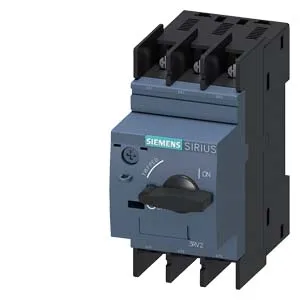
The same 100 kA holds at 240 V and 500 V; at 690 V it drops to 4 kA, so verify the available fault current if feeding from a 690 V transformer. That's a standard requirement for motor protection in most industrial installations and saves adding an external phase monitor relay.
The 45 mm width (one standard module) fits a typical motor starter row alongside a contactor of the same width. Main circuit connection uses ring cable lugs with M3 screws. The control circuit is not separately terminated — this is a self-powered thermal-magnetic breaker, no auxiliary supply needed.
Sizing and coordination
For motor sizing, the 3RV2011-1EA40 covers a specific hp window: 0.33 hp at 230 V, 0.75 hp at 220/230 V, 2 hp at 460/480 V, and 3 hp at 575/600 V. The thermal setting range is not listed explicitly in this record, but the hp ratings define the motor full-load current window it protects. Backup fuse requirements: gL/gG 32 A at 400 V and 500 V, dropping to 25 A at 690 V — the fuses protect the breaker's short-circuit capacity in high-energy faults. Maximum switching frequency is 15 operations per hour in AC-3 duty (motor starting), and the same 15 1/h for AC-3e (enhanced motor starting). That's adequate for most pump, fan, and conveyor cycles; high-repetition applications like rapid indexing may need a contactor rated for more starts per hour.