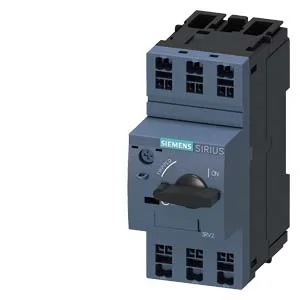
What this breaker does in the panel
It combines a CLASS 10 thermal-magnetic trip curve with phase failure detection, so it protects a three-phase motor from overload, short-circuit, and single-phasing — the most common cause of motor burnouts on a line. The spring-loaded terminals (accepting 2x 0.5 to 4 mm² solid or stranded) speed up panel wiring, and the breaker mounts on a 35 mm DIN rail per DIN EN 60715 with a screw-and-snap-on fastening method, meaning it drops into any standard industrial enclosure without extra brackets.
The interrupting rating is 100 kA at 400 V and 500 V, and 4 kA at 690 V. At 240 V it also holds 100 kA. The gL/gG fuse backup ratings are 50 A at 400 V, 40 A at 500 V, and 35 A at 690 V, so if you need to coordinate with a downstream fuse, those are the maximum sizes the breaker will let through without damage.
Required clearances: 50 mm upwards, 50 mm downwards, 30 mm at the side, and 0 mm forwards and backwards. That zero forwards clearance means the breaker can be mounted flush against a panel door or gland plate, which is useful when you are packing multiple motor starters into a single enclosure.