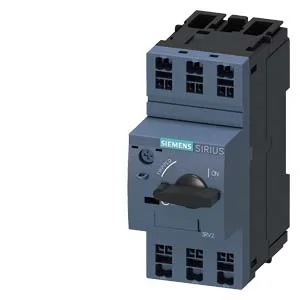
Motor protection circuit breaker for panel integration
The Siemens SIRIUS 3RV2011-1GA20-ZX95 is a motor protection circuit breaker designed for motor protection. It snaps onto a 35 mm DIN rail per DIN EN 60715 using the combined screw and snap-on fastening method, which means it integrates into standard industrial control panels without extra hardware. Trip Class 10 means it will trip within 10 seconds at 7.2× the thermal setting — that's fast enough to protect a standard induction motor from stall or locked-rotor conditions without nuisance tripping on normal starts. Phase failure detection is built in, so if one leg drops on a three-phase motor, the breaker opens before single-phasing cooks the winding. No ground fault detection — that's separate, downstream if needed.
Breaking capacity and short-circuit coordination
Rated breaking capacity at 400 V is 100 kA, and at 690 V it drops to 4 kA. At 500 V it holds 100 kA. That 100 kA at 400 V is high — it handles most industrial fault levels without needing a current-limiting upstream breaker. The 4 kA at 690 V is a hard ceiling; if your panel feeds a 690 V motor on a high-fault bus, verify the available fault current is under that. The gL/gG fuse backup ratings tell you what upstream fuse lets the breaker still coordinate: 50 A at 400 V, 40 A at 500 V, 35 A at 690 V. If you're sizing a feeder, those are the max fuse ratings that preserve the breaker's short-circuit performance.
Lifecycle and sourcing
The closest functional sibling is the 3RV2021-1GA25, which is a physically larger frame (S2 vs S0) with higher current ratings. The 3RV2011-1GA20-ZX95 is the S0 frame, 45 mm wide, 97 mm deep, 106 mm tall. If a panel was laid out for the 3RV2021-1GA25, this won't drop in without re-drilling — the mounting footprint and terminal spacing differ.
Wiring and environmental limits
Main circuit terminals accept 2×(0.5 to 4 mm²) solid or stranded — spring-loaded terminals, so no screw torque to chase. Operating temperature range is -20 to +60 °C; storage and transport range is -50 to +80 °C. Mounting position is any, which helps in tight enclosures. Clearance requirements: 50 mm upwards, 50 mm downwards, 30 mm at the sides, zero forwards and backwards. That 50 mm top/bottom gap is for arc-chute venting — don't cram it against a panel wall.
