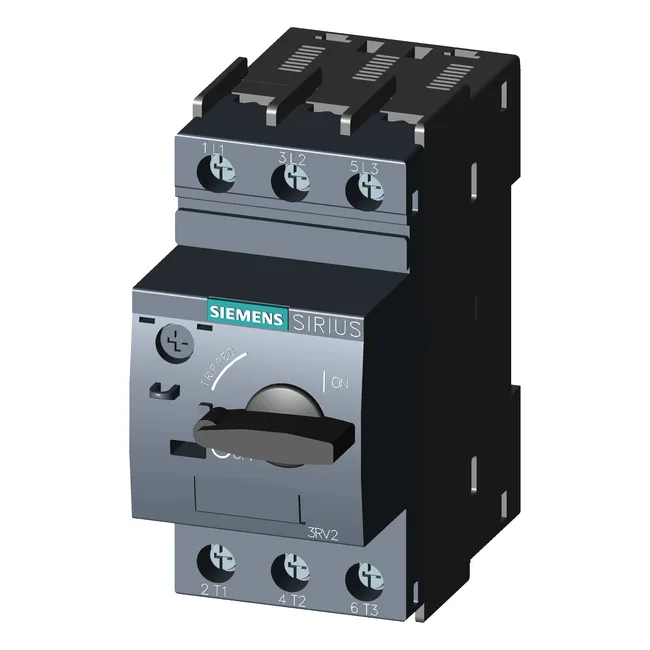
Motor protection circuit breaker, SIRIUS, 6.3 A, 100 kA
It carries a rated current of 6.3 A at both 480 V and 600 V, with a massive 100 kA breaking capacity at 400 V — meaning it can safely interrupt fault currents up to that level without cascading damage upstream in the panel.
At 45 mm wide, it fits standard 45 mm slot spacing in most motor control centers. Depth is 97 mm, height 106 mm. Clearance requirements: 50 mm upward, 50 mm downward, 30 mm at the side, and 0 mm forward/backward — meaning you can pack it tight front-to-back, but leave breathing room above and below. Spring-loaded terminals on the main circuit accept 2× (0.5 to 2.5 mm²) solid or stranded conductors. No screw torque to verify — just strip, insert, and latch.
Short-circuit and auxiliary contact ratings
Short-circuit breaking capacity varies with voltage: 100 kA at 240 V, 400 V, and 500 V; 4 kA at 690 V. At 400 V and 500 V, the rating assumes upstream gL/gG fuses sized at 50 A and 40 A respectively; at 690 V, a 35 A gL/gG fuse is required. Auxiliary contact (integrated into the ZW96 variant) switches: 1 A at 24 V, 0.15 A at 60 V, 0.5 A at 120/125/230 V. These are the dry-contact ratings for the signal circuit — the 0.5 A at 120 V is typical for PLC input modules.
The product lifecycle stage is current — meaning this is an active, in-production catalog item, not a phase-out or NRND part. No last-time-buy concerns; it's a standard BOM line.