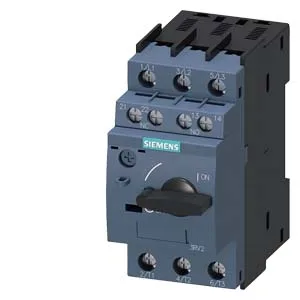
It's designed for motor protection, with phase failure detection built in, and it trips on a Class 10 curve, meaning it disconnects fast enough to protect a standard induction motor during a stall or locked-rotor event. Rated voltage spans 20 to 690 V, so it covers everything from 24 V control transformers up to 690 V industrial mains. Mounts on a standard 35 mm DIN rail (screw and snap-on per DIN EN 60715), and the terminals are screw-type, accepting 2x 0.5 to 2.5 mm² solid or stranded. No special tools — just a screwdriver and a rail.
That means you can butt it against a backplate or a busbar cover without derating. The auxiliary contact ratings are worth noting if you're using it for status feedback: 1 A at 24 V, 0.5 A at 120/125/230 V, and only 0.15 A at 60 V. That's a standard signal contact — don't try to switch a contactor coil directly with it; use a separate relay for that.
For backup fusing, the manufacturer specifies gG cartridge fuses: 50 A at 400 V, 40 A at 500 V, 35 A at 690 V. That's the coordinated short-circuit protection for the breaker itself — if you're building a UL 508A panel, those values will drive your SCCR calculation.
The closest sibling in the SIRIUS family is the 3RV2021-1GA15. Both are motor protection breakers with Class 10 trip curves and the same 45 mm width. The 3RV2021-1GA15 carries higher continuous current ratings — it's the next size up in the same form factor. If your motor FLA is above the 3RV2011's range, the 3RV2021 is the drop-in replacement on the same DIN rail footprint. No rewiring needed; same terminal pattern, same clearance zones.