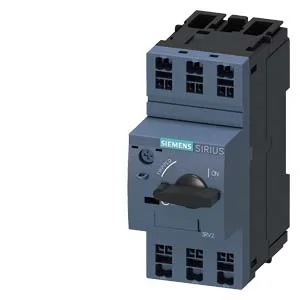
It also includes phase failure detection, so if one phase drops, the breaker opens before single-phasing cooks the motor.
Breaking capacity — what it handles
The interrupting ratings tell you where this breaker can be used without upstream fuses or a larger breaker backing it up. At 240 V and 400 V it is rated for 100 kA; at 500 V it drops to 42 kA; at 690 V it is 4 kA. The gL/gG fuse-limit values at 400 V are 50 A, at 500 V 40 A, and at 690 V 35 A — these are the maximum upstream fuse sizes if you need to coordinate with a fuse ahead of the breaker. For a cement plant panel where fault currents can be high near the main transformer, the 100 kA at 400 V gives you headroom.
The main circuit uses spring-loaded terminals — no screw-clamp torque to verify, just strip and push. Clearance requirements: 50 mm upwards and downwards, 30 mm to the sides, 0 mm forwards and backwards. That 0 mm backwards means it can sit flush against a panel backplate.