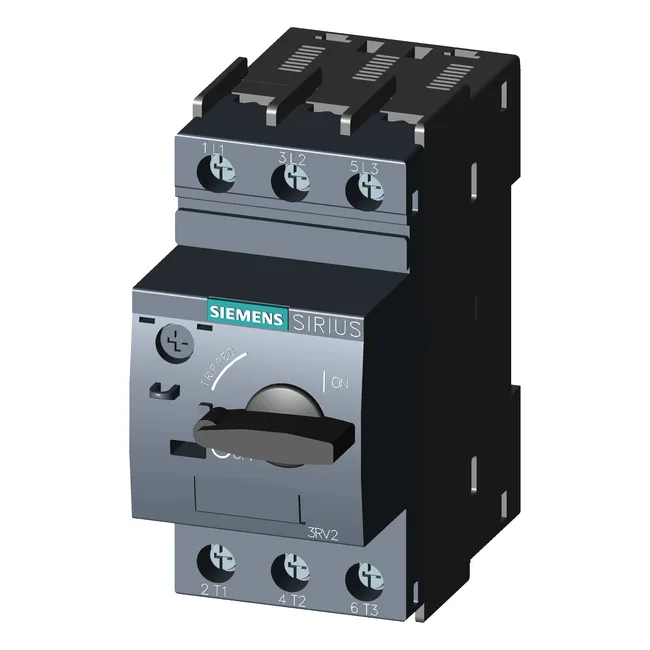
What this breaker does in the cell
It combines a CLASS 10 trip curve with phase failure detection, meaning it clears a locked-rotor condition fast enough to protect standard induction motors — the 15 1/h max switching rate at AC-3 duty tells you it's sized for occasional starting, not continuous jogging. Mounting is screw and snap-on onto 35 mm DIN rail per DIN EN 60715, and the spring-loaded terminals accept 2x 0.5 to 4 mm² solid or stranded conductors. The 45 mm width and 97 mm depth fit standard panel layouts; clearance requirements are 50 mm upwards and downwards, 30 mm at the sides, and zero forwards or backwards — so it can sit flush against a backplate or enclosure wall.
Trip curve and protection scope
The CLASS 10 trip characteristic means the breaker will open within 10 seconds at 7.2× the thermal setting — a standard match for IEC motor starting profiles. The rated voltage range spans 20 to 690 V, so it covers 400 V and 480 V common in North American and European panels. The interrupting capacity drops with voltage: 100 kA at 240 V and 400 V, 42 kA at 500 V, 4 kA at 690 V (–). For a 480 V supply, the breaker is rated 12.5 A continuous — that's the thermal setting, not the magnetic pickup.