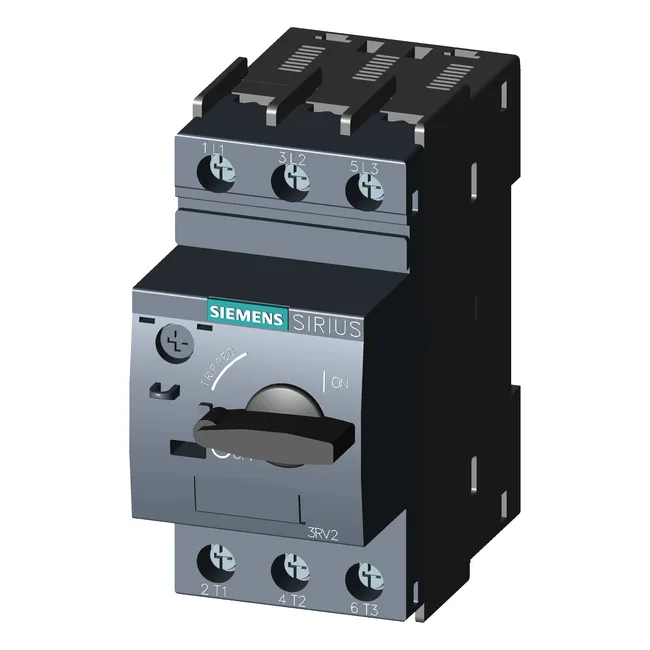
What this SIRIUS breaker does on a motor circuit
It combines a thermal overload relay (CLASS 10 trip curve) with a magnetic short-circuit release in one DIN-rail-mountable unit. The adjustable overload range is 9...12.5 A, and the instantaneous magnetic trip fires at 163 A — meaning it clears a bolted fault fast enough to protect the contactor and cable, not just the motor. Rated operational voltage covers 20...690 V. The interrupting capacity is 100 kA at 240 V and 400 V AC, dropping to 42 kA at 500 V and 6 kA at 690 V AC.
Termination and panel fit
Spring-type terminals on the main circuit and auxiliary contacts — no screwdriver needed for the power wiring, which speeds up panel assembly. The S00 footprint (45 mm wide, 97 mm deep) snaps onto 35 mm DIN rail per DIN EN 60715.
What CLASS 10 means for motor starting
That's the standard for standard-duty induction motors — pumps, fans, conveyors that accelerate to full speed in a few seconds. It won't nuisance-trip on a normal start, but it clears quickly if the rotor locks. For high-inertia loads (centrifuges, flywheels) you'd want CLASS 20 or 30; for submersible pumps or hermetic compressors, CLASS 10 is the right call.