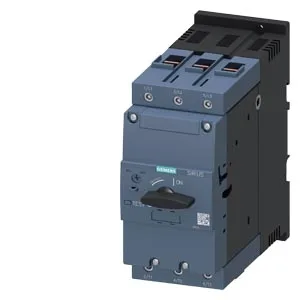
It carries a CLASS 20 trip curve, meaning it allows up to 20 seconds of locked-rotor current before tripping — matching the thermal time constant of standard NEMA design B motors during start-up. No ground-fault detection on this variant; if GF protection is needed, pair it with a separate ground-fault relay or choose a 3RV2 with the GF option. Motor horsepower coverage spans from 5 hp at 110/120 V up to 50 hp at 575/600 V. At 460/480 V it covers 40 hp; at 230 V it handles 20 hp. Use the full-load current setting range on the breaker dial — not the horsepower table — to set the actual trip point per the motor nameplate.
Mounting and wiring — panel integration
Main circuit terminals accept solid or stranded copper: 2x (2.5 … 16 mm²) on the line side and 2x (2.5 … 50 mm²) or 1x (10 … 70 mm²) on the load side. Screw-type terminals — torque to the manufacturer's spec stamped on the device. The 176 mm depth and 70 mm width mean it occupies a single 70 mm DIN-rail slot.
Environmental and operating limits
The storage limit governs handling, not running — the device can survive cold warehouse transit but must be within operating range before energizing. Rated insulation voltage is 20 … 690 V. Maximum switching frequency at AC-3 duty is 15 operations per hour — adequate for motor starting cycles but not for high-repetition jogging or inching applications.