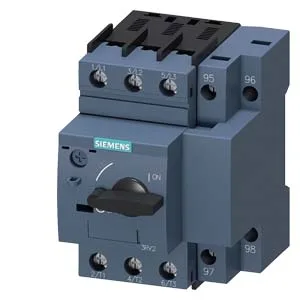
Breaking capacity hits 100 kA at 400 V and 500 V, and 10 kA at 690 V — those numbers govern whether this breaker can interrupt a bolted fault on a high-capacity transformer secondary without upstream fuses needing to clear first. At 240 V it still delivers 100 kA, so it covers most North American 480Y/277 V panelboards as well. Motor horsepower ratings are 0.5 hp at 200/208 V and 220/230 V, and 0.17 hp at 230 V — these are the NEMA-style reference points for sizing the breaker to the motor nameplate. For IEC applications, the thermal setting range (not listed here) is the actual selection parameter. The main contacts use M3 screw terminals, accepting 2x (0.5 to 1.5 mm²) or 2x (0.75 to 2.5 mm²) solid or stranded copper — this covers the typical control-power and small-motor branch wiring sizes up to about 14 AWG. The screw-type terminals are the standard for permanent panel wiring where vibration resistance matters. Maximum switching rate is 15 operations per hour in AC-3 duty — that is the motor-starting category. This is not a device for frequent jogging or reversing service; it is sized for protection, not cycling.
Envelope is 97 mm deep × 65 mm wide × 97 mm tall. Clearance requirements: 50 mm upward and downward, 30 mm at the sides, 0 mm forward and backward. Those are the minimum free-air gaps for arc-quenching and thermal dissipation — cramming it tighter derates the breaking capacity.