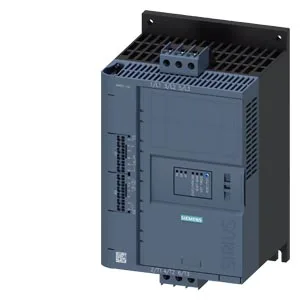
Trip class and motor protection logic
The 3RW5213-3AC04 is configured with Trip Class 10A as default, with selectable 10E and 20E classes per IEC 60947-4-2 — this determines the thermal overload curve the soft starter follows during a stall or jam condition. A minimum load threshold of 15 % relative to the smallest settable Ie means the soft starter will not attempt to regulate below that floor — useful when the downstream motor is oversized relative to the actual pump or fan load.
Supply voltage and ambient derating
Rated supply voltage spans 200 to 480 V AC, covering common 230/400/480 V industrial feeds without a tap-change transformer. The control supply is 24 V DC, which keeps the logic isolated from the power stage and allows a standard 24 V control transformer or UPS-backed bus to hold the soft starter in a known state during a voltage dip.
Fieldbus and communications integration
This SIRIUS soft starter carries PROFIBUS, Modbus RTU, Modbus TCP, EtherNet/IP, and PROFINET standard interfaces natively — no separate gateway module needed for most plant-floor networks. PROFIenergy is supported in connection with the PROFINET Standard communication module, which allows the drive to shed load during production pauses without cycling the main contactor. The analog output is configurable as 4-20 mA (default) or 0-10 V via the High Feature HMI, giving the DCS or PLC a real-time current or torque signal without a separate transducer.
Mechanical footprint and panel clearances
Dimensions are 275 mm height, 170 mm width, 152 mm depth — screw fixing to the back panel, not DIN rail, so the mounting plate must be drilled for the fixing centres. Required clearances: 100 mm upwards, 75 mm downwards, 10 mm forwards, 5 mm at the side, 0 mm backwards — the zero rear clearance means it can sit flush against the back panel, saving depth in a shallow enclosure.
Approvals and compliance documentation
CE marking, UL approval, and CSA approval are all confirmed on the record — the unit carries the marks needed for North American and European panel certification without a separate component-level review.