Trip Class 10A default — motor protection timing
The 3RW5213-3TC04 ships with Trip Class 10A as default, per IEC 60947-4-2. You can also select Class 10E or 20E through the parameter set if the load inertia demands a longer ramp. The minimum settable load current is 15% of the smallest Ie setting — so if you're running a lightly loaded motor, confirm the motor FLA stays above that threshold to avoid nuisance tripping or loss of protection coordination.
200–480 V range, 5.5 A minimum — voltage and current envelope
Rated 200–480 V, this soft starter covers the common low-voltage three-phase systems: 208 V, 230 V, 400 V, and 480 V. The minimum operating current is 5.5 A — below that, the internal current measurement may not resolve accurately enough for the protection algorithms to work as designed. If the panel sits near a furnace line or in a hot mill environment, budget for reduced continuous current above 40 °C — the derating curve is in the product manual.
Fieldbus selection — PROFIBUS, Modbus RTU/TCP, EtherNet/IP, PROFINET
This soft starter supports PROFIBUS, Modbus RTU, Modbus TCP, EtherNet/IP, and PROFINET. That covers the major industrial Ethernet and serial fieldbuses — no separate communication module needed for these protocols. PROFIenergy is available when used with the PROFINET standard communication module, allowing the drive to participate in energy management profiles during idle periods. Control supply is 24 V DC. Remote reset is possible by cycling the control supply voltage — useful for unattended restart after a fault, but make sure the safety circuit logic allows automatic restart before enabling that feature.
Panel clearances and mounting — 170 x 275 x 152 mm
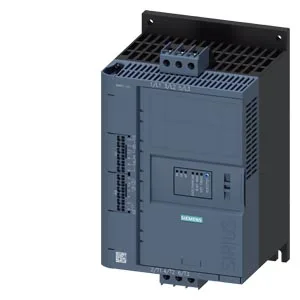
The 3RW5213-3TC04 is screw-fix mounted, not DIN-rail snap-on. Dimensions are 170 mm wide, 275 mm high, 152 mm deep. Required clearances: 100 mm above, 75 mm below, 10 mm in front, 5 mm at the sides, and 0 mm at the back — it can sit flush to the back panel. The zero rear clearance is unusual for a device this size; it helps when the back panel has busbars or wiring troughs that can't be shifted. Mounting position allows ±10° rotation and can be tilted forward or backward on a vertical surface, giving some flexibility in crowded panels.
Lifecycle and compliance — active production, UL/CSA/CE
Shock resistance is 15 g / 11 ms — the device can withstand 15 g for 11 ms without contact lifting; above 12 g / 11 ms potential contact lifting is noted, so avoid mounting it directly on a panel that sees repeated shock events above that threshold.
Pump and soft-torque features
Soft Torque and Pump Ramp Down are both available. Soft Torque reduces the initial torque spike on start — useful for belt-driven loads or gearboxes where a hard start accelerates wear. Pump Ramp Down provides a controlled deceleration ramp, preventing water hammer in pumping systems when the motor stops. Firmware updates are supported in the field, and an error logbook is available with special accessories. There is no analog output and no torque control — this is a standard soft starter, not a variable-speed drive. Auto-reset is configurable for unattended restart after a cleared fault.