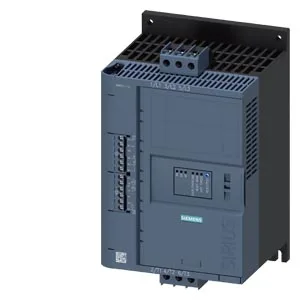
Panel fit and mounting — 275 x 170 x 152 mm, screw-fixed
The 3RW5215-1AC14 measures 275 mm high, 170 mm wide, and 152 mm deep, with screw fixing to the back panel. It allows ±10° rotation and can tilt forward or backward on a vertical surface, so you can nudge it into an existing enclosure without redrilling the whole backplate. Clearance requirements are specific: 100 mm above, 75 mm below, 10 mm forward, 0 mm backward, and 5 mm at the sides. The zero backward clearance means it can sit flush against a rear panel wall, which helps when the enclosure depth is tight.
Motor starting profile — Trip Class 10A, minimum 11.5 A
Rated for a minimum setting of 11.5 A, this soft starter is sized for smaller motor loads. The Trip Class is selectable: default CLASS 10A, with options for 10E or 20E per IEC 60947-4-2. The minimum load threshold is 15% of the smallest settable Ie, so it handles light-load starts without nuisance tripping. Service factor is 1 — no built-in overload margin beyond the nameplate rating, so set the motor FLA accurately in the parameters.
Network integration — PROFIBUS, Modbus, EtherNet/IP, PROFINET
This unit ships with onboard PROFIBUS and Modbus RTU, plus Modbus TCP and EtherNet/IP support. PROFINET standard is also available, and with the PROFINET communication module you get PROFIenergy for coordinated energy management in automated lines. The analog output is configurable as 4-20 mA (default) or 0-10 V, parameterizable through the High Feature HMI. This gives the PLC real-time current feedback for load monitoring or predictive maintenance triggers.
Operating conditions and approvals
Shock resistance is 15 g / 11 ms, with potential contact lifting at 12 g / 11 ms, so it holds up in industrial environments with vibration from nearby contactors or drives. Carries CE, UL, and CSA approvals, covering North American and European regulatory requirements. The product category is hybrid switching devices, meaning it uses a semiconductor for soft starting and an electromechanical bypass for steady-state running — lower heat dissipation in the panel than a pure solid-state starter.