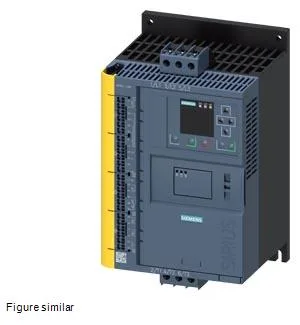
Hazardous-area soft starter with multi-protocol fieldbus
The Siemens 3RW5513-3HF04 is a soft starter carrying ATEX and IECEx certification, so it can be installed in Zone 2 / Zone 22 hazardous areas where motor starting must avoid ignition sources. Rated for 200-480 V AC supply, it covers the common low-voltage motor voltages found in European and North American industrial plants — no transformer needed for 230 V or 400 V feeds.
Fieldbus and analog feedback for control integration
Built-in PROFIBUS, Modbus RTU, Modbus TCP, and EtherNet/IP support means this soft starter talks directly to most common PLC networks without an external gateway — parameterize the start ramp, current limit, and fault log over the bus. The analog output can be configured as 4-20 mA or 0-10 V to feed motor current or voltage to a local indicator or remote I/O — useful for trending start current or monitoring load changes.
Safety, reliability, and motor protection features
The B10d value of 1,588,000 cycles is a reliability figure for the safety-related parts — relevant when the soft starter is used in a safety function like safe torque off (the safe state is open load circuit). Motor heating function provides thermal protection by modeling the motor's temperature rise during starting, reducing nuisance trips on long acceleration times. Service factor 1.15 allows the soft starter to handle 15% continuous overload above its rated current without tripping — typical for pumps and fans that occasionally run above nameplate. DC braking, pump ramp down, breakaway pulse, and torque control are all built in — no external braking module needed for controlled stopping or jogging.
Regulatory approvals and compliance documentation
UL and CSA approvals cover North American installations; CE marking covers the European low-voltage and EMC directives. ATEX and IECEx certification means the unit carries a nameplate marking suitable for explosive atmospheres — the documentation package includes the certificate number for the panel builder's dossier.
Mounting dimensions and clearance requirements
The unit measures 152 mm deep, 170 mm wide, and 275 mm high — fits a standard 400 mm wide enclosure depth. Minimum clearance around the unit: 100 mm above, 75 mm below, 10 mm in front, 5 mm at the sides, and 0 mm behind — plan the enclosure layout so ventilation airflow is not blocked. Power wiring terminals accept solid conductors from 1.0 to 10 mm² — two terminals per phase for daisy-chaining or dual-cable runs.