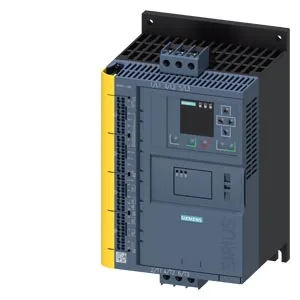
ATEX-certified soft starter with multi-protocol fieldbus
The Siemens 3RW5513-3HF14 is a soft starter certified for use in explosive atmospheres (ATEX Yes, IECEx Yes) and carries UL and CSA approvals — a rare combination that lets it serve both European Zone-rated installations and North American UL-listed panels without a separate barrier device. Rated supply voltage is 200-480 V AC (50/60 Hz), covering the common low-voltage motor distribution range across global sites.
Trip class and motor protection flexibility
Trip class is selectable between CLASS 10A, 10E (default), 20E, and 30E per IEC 60947-4-2 — the 10A/10E setting protects standard squirrel-cage motors during start, while 20E or 30E accommodates high-inertia loads (centrifuges, crushers) that need a longer acceleration ramp without nuisance tripping. Accuracy Class 5 per IEC 61557-12 means the current measurement error stays within ±5 % of reading — sufficient for motor overload protection but not for revenue-grade energy metering. The integrated fail-safe function (with fail-safe: 1) supports SIL-rated safety circuits; the safe state is an open load circuit, which means the output de-energises to a known off condition on fault.
Fieldbus connectivity and commissioning tools
Supports PROFIBUS, Modbus RTU, Modbus TCP, and EtherNet/IP on the same hardware — no swapping of communication modules needed when the control network changes. Built-in event list, error logbook, and trace function let a commissioning engineer capture start-up current profiles and fault sequences without an external data logger. Analog output is configurable as 4-20 mA (default) or 0-10 V, feeding motor current or torque signals to a PLC analog input or local panel meter.
Mounting dimensions and clearance requirements
Width 170 mm, height 275 mm, depth 152 mm — the footprint is sized for a standard 400 mm-wide enclosure backplate with room for a line-side contactor and overload relay on the same DIN rail. Required clearances: 100 mm upwards, 75 mm downwards, 5 mm at the side, 10 mm forwards, 0 mm backwards — the zero rear clearance means it can sit flush against the backplate, saving depth in shallow enclosures.