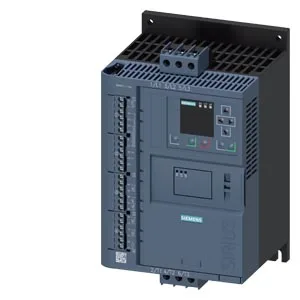
Hazardous-area soft starter with flexible trip-class selection
The Siemens 3RW5514-1HA05 is a soft starter carrying ATEX and IECEx certification, meaning it's approved for installation in explosive atmospheres where motor starting equipment must not become an ignition source. This is the primary differentiator from standard soft starters — if your line runs in a gas or dust zone, this part keeps the panel compliant without an external isolation barrier. Rated for 200-600 V supply, it covers the common global industrial voltages — 230 V, 400 V, 480 V, and 575 V — so it fits across European, North American, and Asian panels without a voltage-range change.
Panel fit and cooling clearances
The unit measures 152 mm deep, 170 mm wide, and 275 mm high. For natural convection cooling, Siemens specifies clearances: 100 mm above, 10 mm in front, 75 mm below, 5 mm at the sides, and 0 mm at the rear. That 100 mm upward gap is the one that catches panel builders — skimp on it and the internal heatsink starves, derating the output current. Termination uses screw terminals accepting 2x (1.0-2.5 mm²) and 2x (2.5-10 mm²) solid conductors — the dual-range clamp handles both control wiring and power tails without needing ferrule adapters.
Fieldbus, feedback, and motor control features
On the network side, the 3RW5514-1HA05 ships with PROFIBUS onboard and supports Modbus TCP, but no Modbus RTU or EtherNet/IP. For PROFINET environments with energy monitoring, the PROFIenergy profile is supported when paired with the PROFINET communication module. The analog output defaults to 4-20 mA but can be switched to 0-10 V, giving a speed or current signal back to the PLC or drive controller. Motor control features include DC braking for rapid stopping, voltage ramp for smooth acceleration, pump ramp down to reduce water hammer in pumping stations, torque control for precise starting, and a breakaway pulse to break free sticky or high-inertia loads. The 1.15 service factor means the unit can sustain 115% of rated current continuously — useful when the motor runs at the edge of its thermal limit. Diagnostics include an event list, error logbook, trace function, motor heating model, and firmware update capability over the fieldbus. The accuracy class is 5 per IEC 61557-12, adequate for load monitoring but not for revenue-grade metering.