What it is and what it does
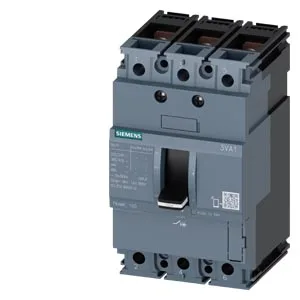
The Siemens 3VA1032-3ED32-0BH0 is a SENTRON molded case circuit breaker (MCCB) rated for 32 A continuous current on a 3-pole line-protection duty. It carries a TM210 thermal-magnetic overcurrent release — the thermal element handles overloads, the magnetic element clears short-circuits — and is fitted with an undervoltage release (UVR) as the integrated auxiliary trip. The auxiliary contact block provides two auxiliary switches plus one trip alarm switch (HQ version), so the breaker can signal its status back to a PLC or annunciator panel without a separate interface module.
Breaking capacity — what the numbers mean for coordination
This breaker's interrupting rating varies sharply with system voltage: 75.6 kA at 240 V, 52.5 kA at 415 V, 32 kA at 440 V, and 7.5 kA at 690 V. For a 415 V distribution panel — the most common industrial voltage in much of the world — 52.5 kA is a high-interrupting rating that lets it serve as the main or feeder breaker in most low-voltage switchgear without needing a current-limiting upstream device. At 690 V the rating drops to 7.5 kA, which still covers many motor-control-center applications but demands a selectivity study if the available fault current exceeds that figure.
Thermal derating — the real-world current limit
The 32 A rating holds at ambient temperatures up to 50 °C. Above that it derates: 30.72 A at 55 °C, 30.08 A at 60 °C, 29.44 A at 65 °C, and 28.8 A at 70 °C. If this breaker sits inside a sealed, uncooled enclosure near other heat sources, the 50 °C threshold is easy to cross — plan the panel ventilation or uprate the frame if the load is a solid 32 A and the ambient runs hot.
Panel fit and integration
The 3VA1032-3ED32-0BH0 measures 70 mm deep, 76.2 mm wide, and 130 mm tall — a standard MCCB footprint that fits most DIN-rail or panel-mount enclosures. The front face carries an IP40 protection rating, meaning it is protected against tools and wires greater than 1 mm but not against water ingress; keep it behind a gland plate or enclosure door in washdown areas. The undervoltage release (UVR) is factory-installed and wired to the control circuit — if the control voltage drops, the breaker trips, which is the expected behavior for emergency-stop or safety-related isolation schemes.
