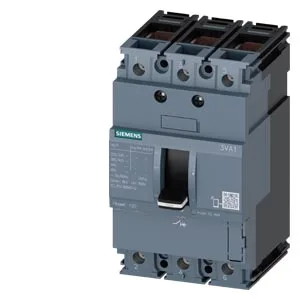
The Siemens 3VA1032-4ED36-0HA0 is a 3-pole SENTRON molded case circuit breaker rated for 32 A continuous current (Iu) at 40 °C, with a TM210 thermal-magnetic release and a shunt trip (STL) for remote opening. Its interrupting ratings climb to 121 kA at 240 V, 75.6 kA at 415 V, 52.5 kA at 440 V, and 11.9 kA at 690 V — numbers that govern selectivity and SCCR in the distribution panel, not just the breaker itself. It is a straight thermal-magnetic MCCB with a shunt trip for emergency or remote disconnect, sized for a 32 A feeder.
At 55 °C it derates to 30.72 A, at 60 °C to 30.08 A, at 65 °C to 29.44 A, and at 70 °C to 28.8 A. The TM210 release is the fixed thermal-magnetic element; there is no electronic adjustment or communication. For a panel-builder, that means the trip curve is set at the factory and the only field wiring is the shunt-trip coil (listed as 3VA9688-0BL30) plus the power terminals.
What this breaker does not include (and why that matters for a swap)
No auxiliary contacts either, so remote status monitoring requires an external accessory block. The shunt trip (STL) is factory-installed; verify the coil voltage matches the control circuit before wiring.