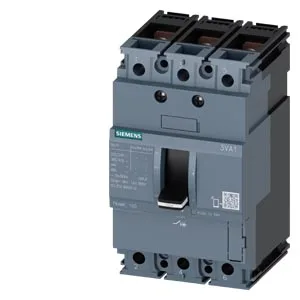
The Siemens 3VA1040-4ED32-0AA0-ZD00 is a 3-pole IEC frame 100 circuit breaker from the 3VA1 series, rated 40 A with a breaking capacity class S — Icu = 36 kA at 415 V. The overload protection is fixed at Ir = 40 A (thermal-magnetic TM210 release), and the short-circuit protection is fixed at Ii = 10 × In, meaning the magnetic trip fires at 400 A. The 'FTFM' designation indicates a fixed thermal, fixed magnetic release — no field-adjustable dials, so the protection curve is locked at the factory. That simplifies ordering for a BOM line where the settings must not drift, but it also means the breaker is not a candidate for coordination studies that require adjustable short-circuit pickup.
This specific variant includes a nut keeper kit for DC Power OEM assembly in China, which is a factory-fit accessory that secures the breaker during transport and panel integration. The nut keeper is not a field-installed option; it is part of the order-code suffix ZD00. If the BOM requires that kit, this exact code is the one to specify — a standard 3VA1040-4ED32-0AA0 without the ZD00 suffix will not include it.
The 3VA1 frame 100 mounts on a DIN rail per IEC 60715, with a standard 3-pole width of 108 mm (3 × 36 mm modular spacing). The nut keeper kit holds the breaker in place during wiring and prevents the mounting screws from backing out under vibration — relevant for OEM panels that ship assembled.