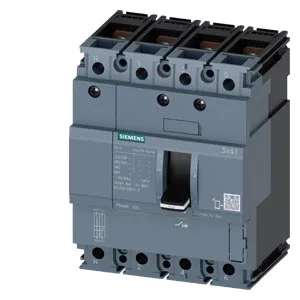
That's a standard thermal-magnetic curve for feeder protection — no electronic adjustments, just reliable bimetal and solenoid action. If you're used to the older 3VL series, the 3VA platform shrinks the footprint while keeping the same interrupting ratings.
Breaking capacity at different voltages
This MCCB delivers 121 kA at 240 V AC, 75.6 kA at 415 V AC, 52.5 kA at 440 V AC, and 11.9 kA at both 500 V and 690 V AC. The steep drop above 500 V is typical for a 50 A frame — the arc energy scales with voltage, and the interrupter has limits. For a 480 V delta service (common in North American industrial), you're still above 50 kA, which covers most transformer-fed secondary faults.
Temperature derating and power loss
At 55 °C it drops to 49 A, at 60 °C to 48 A, at 65 °C to 46 A, and at 70 °C to 45 A. That's a gentle slope; you lose only 10 % at the max operating temperature. Maximum power loss is 14.6 W per pole, which is modest for a 50 A frame — helps keep the enclosure cool when you stack multiple breakers side by side.
Physical fit and aux switch configuration
The 4-inch width (101.6 mm) is the standard 4-pole MCCB footprint — it occupies four 25 mm module spaces on a DIN rail or panel-mount plate. The depth of 70 mm (2.76 in) is shallow enough that it clears most gland plates and back-panel wiring troughs. This breaker comes with 4 auxiliary switches (HQ type) pre-installed, so you get status feedback without adding external contact blocks. The basic switch variant is 3VA10504ED420AA0 — useful to know if you're ordering spare parts.
Environmental and operating limits
If you need those extras, look at the 3VA1 with electronic trip or add-on modules.