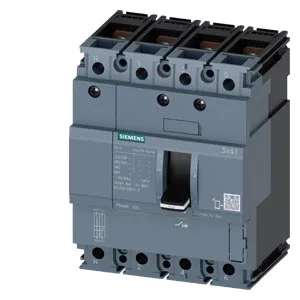
The 3VA1050-4ED42-0AF0 is a 4-pole SENTRON molded case circuit breaker (MCCB) rated for 50 A continuous at 40 °C, with a TM210 thermal-magnetic release. That 50 A holds flat through 50 °C, then derates to 45 A at 70 °C — so in a warm panel you lose 5 A off the top, not the full curve. Interrupting capacity hits 121 kA at 240 V AC, dropping to 75.6 kA at 415 V and 52.5 kA at 440 V; at 690 V it still clears 11.9 kA. That's a lot of fault-clearing headroom for a 50 A frame — it'll ride through a high-fault distribution point without upstream coordination headaches. The auxiliary switch pack is one NO/NC auxiliary plus one trip-alarm switch (HQ type), enough to signal the PLC or annunciator on fault without an add-on module.
Footprint is 101.6 mm wide by 130 mm tall by 70 mm deep — a 4-inch wide body that fits standard MCCB panel cutouts. No DIN-rail mount; this is a bolt-on frame. The 4-pole design means it takes up the same width as a 3-pole plus one module, so verify the enclosure gutter space and busbar tap-off spacing before committing the layout.
What the TM210 release means for coordination
The TM210 overcurrent release is a thermal-magnetic type — thermal element handles overloads (inverse-time curve), magnetic element handles short-circuits (instantaneous pickup). If you need electronic adjustability or zone-selective interlocking, you'd step up to an ETU release in the same frame. For a simple feeder or distribution panel, the TM210 is the workhorse choice.