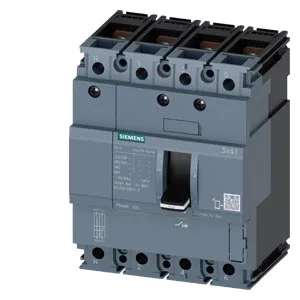
The 4-pole configuration (three phases plus neutral) makes it the right choice for three-phase four-wire systems where you need neutral protection. The TM210 overcurrent release combines a thermal element for overload protection and a magnetic element for short-circuit protection, tuned to a fixed 10× I_n magnetic trip.
Breaking capacity — what those numbers mean for your fault level
At 240 V it's rated for 121 kA — that's a very high capacity, typical for a large-frame MCCB used near a transformer secondary. At 415 V it drops to 75.6 kA, at 440 V to 52.5 kA, and at 500 V and 690 V it holds at 11.9 kA. The steep drop above 440 V is characteristic of this class: the arc becomes harder to extinguish as voltage rises, so the breaker's ability to interrupt falls off.
Above that it begins to derate: 62 A at 55 °C, 61 A at 60 °C, 60 A at 65 °C, and 58 A at 70 °C. The breaker measures 130 mm high, 101.6 mm wide, and 70 mm deep, which fits standard SENTRON 4-pole MCCB mounting footprints. Maximum power loss is 19.8 W — that's the heat dissipated at rated current. In a sealed, high-density panel, that heat has to be managed; it's not trivial if you're stacking multiple breakers in a small enclosure.
Undervoltage release and auxiliary release
The UVR is wired separately from the main power path; verify the control voltage rating matches your panel's auxiliary supply.