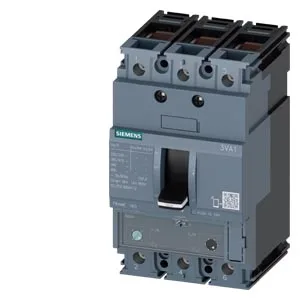
The Siemens 3VA1132-4EF36-0BH0 is a SENTRON molded case circuit breaker (MCCB) configured for line protection, carrying a 32 A rated continuous current (Iu) that holds across ambient temperatures from 40 °C through 50 °C before derating begins — at 55 °C it's still good for 30.72 A, and at 70 °C it delivers 28.8 A.
Interrupting capacity and selectivity
The interrupting ratings climb to 121 kA at 240 V, 75.6 kA at 415 V, 52.5 kA at 440 V, and 11.9 kA at 690 V. No electronic trip unit here, so no auxiliary power needed for the trip logic.
Integrated undervoltage release and auxiliary contacts
That's a common requirement for safety circuits or emergency-stop chains where loss of control power must open the main disconnect.
Mounting and environment
Dimensions are 130 mm height, 76.2 mm width, 70 mm depth — fits standard SENTRON 3VA panel cutouts and busbar systems. Front face carries IP40 protection, so it's splash-resistant from the front but not sealed for washdown. The latching endurance is rated at 15,000 operations, which is typical for a distribution MCCB — not a switching-duty device, but fine for infrequent manual operation and fault clearing.