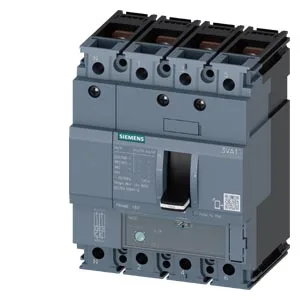
What this MCCB carries — and what that means for your panel
The Siemens SENTRON 3VA1140-3GE42-0AA0 is a 4-pole molded case circuit breaker rated at a continuous 40 A, with a TM220 thermal-magnetic overcurrent release. That TM220 designation means the thermal element is fixed at 40 A (no adjustment), and the magnetic short-circuit pickup is fixed at 220 A — so it's a straight line-protection device, not a motor-protection or adjustable model. The 75.6 kA breaking capacity at 240 V drops to 52.5 kA at 415 V, 32 kA at 440 V, and 11.9 kA at 500/690 V — the interrupting capability shrinks fast above 415 V, so verify the available fault current at your system voltage before committing the BOM line.
Thermal derating and panel integration
Rated 40 A all the way up to 50 °C ambient; above that it starts to taper — 39 A at 55 °C, 38 A at 65 °C, 37 A at 70 °C. That's a shallow derating curve, so in a warm enclosure you lose only 3 A at the top end. The 70 mm depth and 101.6 mm width fit a standard 4-pole MCCB footprint on DIN rail or panel-mount. IP40 on the front means it's protected against tools and wires >1 mm, but not against dust ingress — keep it inside a sealed enclosure if the environment is dirty.
Lifecycle and sourcing posture
The lifecycle stage is marked current — this is an active-production part, not a phase-out or NRND line. No official successor exists because none is needed. For a BOM freeze or a line-down replacement, this exact order code is the one to specify. Sourced and quoted to order against an RFQ through independent distribution; availability and current pricing confirmed at quote time.
What the ratings mean for the buyer's decision
The 40 A rating is the continuous current at 40 °C — that's the number you compare against your load's full-load amps. The breaking capacity at your system voltage is the real gate: at 415 V it's 52.5 kA, which covers most industrial secondary-distribution panels, but at 690 V it's only 11.9 kA. If your available fault current exceeds that, this breaker won't clear the fault safely. The 800 V rated insulation voltage confirms it's suitable for 690 V systems electrically, but the interrupting limit is the binding constraint.
