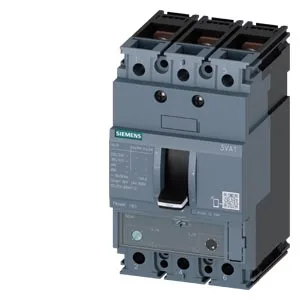
What this MCCB delivers
The Siemens 3VA1140-5EF32-0BH0 is a SENTRON molded case circuit breaker (MCCB) rated for line protection, carrying 40 A continuously at 40 °C ambient — no derating needed until you cross 55 °C, where it drops to 39 A, and 37 A at 70 °C. That 70 °C operating ceiling is the same as the maximum ambient the breaker sees in a hot panel; the storage range of -40 to 80 °C covers transit and warehouse conditions. At 415 V it still handles 121 kA, at 440 V it's 75.6 kA, and at 500/690 V it holds 17 kA. The 3-pole design fits three-phase circuits. An undervoltage release (UVR) is built in — if the control voltage drops below its dropout threshold, the breaker trips, protecting downstream equipment from brownout conditions or restarting on an unstable supply. The basic switch core is 3VA11405EF320AA0, and the insulation voltage is rated at 800 V, which covers most 400/480/690 V systems with margin.
Panel fit and thermal reality
Power loss is 13.3 W maximum — that's the heat the breaker dissipates at full rated current. In a sealed enclosure with multiple breakers, that heat adds up; the thermal derating curve above 55 °C is the guide for grouping.