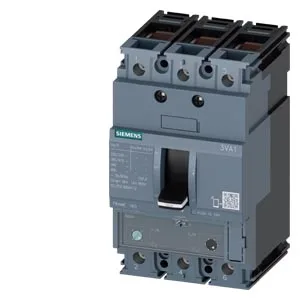
What this MCCB is and what it does
The Siemens 3VA1140-5EF36-0AF0 is a SENTRON molded case circuit breaker (MCCB) designed for line protection — the primary job is protecting cable and buswork against short-circuit and overload in a distribution panel. It is a 3-pole unit rated 40 A continuous at 40 °C, fitted with a TM240 thermal-magnetic trip unit that provides fixed thermal and magnetic pickup curves. The breaker holds the unit on the grid for feeder circuits in industrial switchboards, motor control centers, or building power distribution, provided the available fault current stays within the published breaking capacities.
Breaking capacity — the real number depends on your system voltage
This MCCB delivers 187 kA at 240 V AC, 121 kA at 415 V, 75.6 kA at 440 V, and 17 kA at both 500 V and 690 V. The 187 kA figure at 240 V is what you need for high-fault locations near a large step-down transformer; the 121 kA at 415 V covers most European industrial distribution. At 690 V the breaker still clears 17 kA, which is adequate for many 690 V motor circuits but not for a main tie near a utility transformer. The rated insulation voltage is 800 V, so the breaker is rated for use on 690 V systems without additional series protection, provided the prospective fault current does not exceed the 17 kA limit.
Current derating — the 40 A rating holds to 50 °C
The 40 A continuous rating is valid from 40 °C through 50 °C ambient. At 55 °C it derates to 39 A, at 65 °C to 38 A, and at 70 °C to 37 A. For a panel that runs hot — say a packed MCC bucket near a transformer — the 37 A at 70 °C figure governs the actual load you can hang on this breaker. The maximum power loss at rated current is 10.8 W, which is modest for a 3-pole MCCB and matters for thermal coordination inside a sealed enclosure.
Physical fit and auxiliary switch configuration
The breaker measures 130 mm high, 76.2 mm wide, and 70 mm deep — standard 3-pole MCCB footprint for the 3VA frame size. It ships with one auxiliary switch and one trip alarm switch (HQ type), factory-installed. The auxiliary switch signals the open/closed state; the trip alarm switch indicates a trip from the overcurrent release, not from manual opening. Both are wired to the terminal block on the front face. No undervoltage release is fitted, and no communication module is present on this variant — it is a standalone thermal-magnetic breaker for hardwired distribution.
