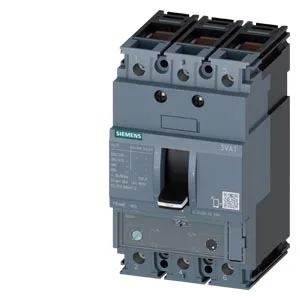
What this MCCB is and what it carries
The Siemens SENTRON 3VA1140-5EF36-0CA0 is a 3-pole molded case circuit breaker (MCCB) rated for line protection, with a TM240 thermal-magnetic overcurrent release. Its continuous current rating holds 40 A from 40 °C up through 50 °C, then derates to 39 A at 55–60 °C and 38 A at 65 °C, finally 37 A at 70 °C — that thermal curve matters when you pack this into a warm enclosure. The interrupting capacity is the headline: 187 kA at 240 VAC, 121 kA at 415 V, 75.6 kA at 440 V, and 17 kA at 500 V and 690 V. That 187 kA at 240 V means it handles high available fault current on a 240 V distribution bus without needing an upstream current-limiting fuse.
Undervoltage release and panel integration
This variant ships with an integrated undervoltage release (UVR) — the auxiliary release type is explicitly an undervoltage release. That means the breaker trips automatically if the control voltage drops below a threshold, which is standard for safety circuits or motor feeder protection where you want a loss-of-voltage shutdown. It fits a 76.2 mm wide (3 in) DIN-rail footprint, 130 mm tall, 70 mm deep — three modules wide on the rail. The rated insulation voltage is 800 V, so it's comfortable on 480/600 V systems. Power dissipation maxes at 13.3 W; factor that into your enclosure thermal budget.
How it compares to the 3VA1110 sibling
The closest functional peer is the 3VA1110-5ED36-0AA0. Both are 3-pole SENTRON MCCBs with a 40 A frame at 40 °C. The core difference: the 3VA1110 carries a lower interrupting capacity — typically 65 kA at 240 V versus this unit's 187 kA. If your panel's available fault current exceeds 65 kA at 240 V, the 3VA1140 is the required choice. The 3VA1110 also lacks the undervoltage release that this unit includes. Footprint is the same 76.2 mm width, so it drops into the same DIN-rail slot without rewiring — but the UVR wiring needs to be accounted for in the control circuit.
